
Ordo Hospitalarius S. Ioannis de Deo
Via della Nocetta, 263
00164 Roma (RM)
Tel.+39 06 6604981
Tel.+39 06 6637102
info@ohsjd.org
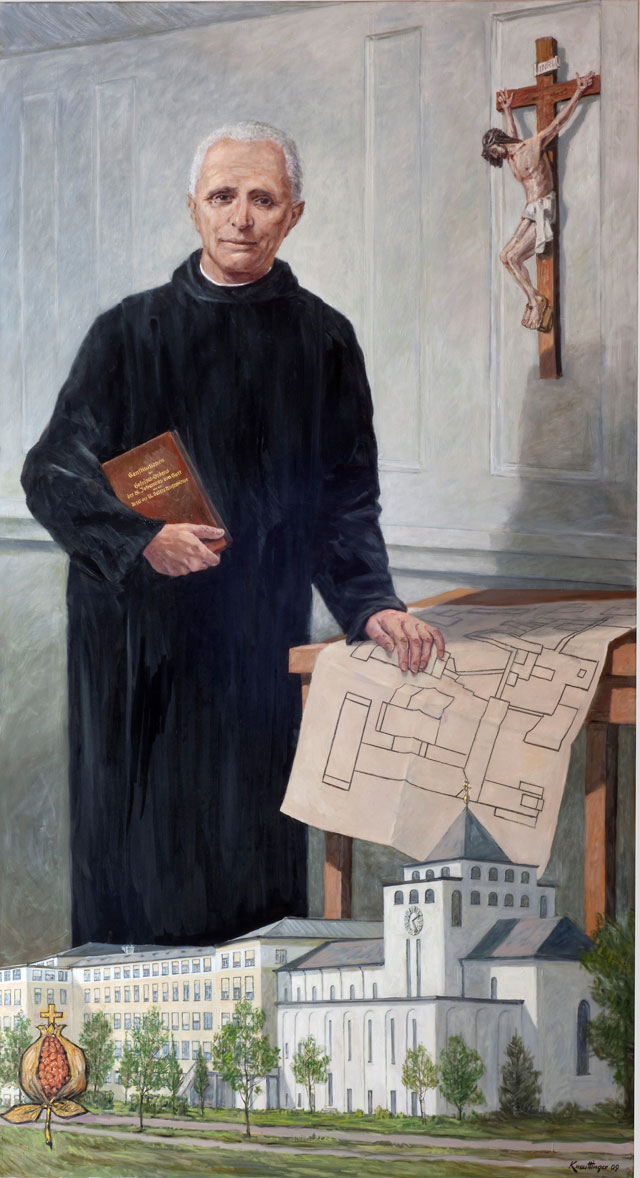 Eustace
Kugler, the sixth child of Michele, a blacksmith and farrier, and Anna Maria
Schuster, was born on January 15, 1867, in Neuhaus, a tiny village near
Nittenau in the Province and Diocese of Regensburg, Germany. Baptized on the
same day, he was given the name Joseph. From his earliest years, he showed an
uncommon inclination toward piety and Christian virtues, along with a lively
intelligence and an open, cheerful, and generous character. Simple, innocent,
and candid, he led a hard and difficult childhood.
Eustace
Kugler, the sixth child of Michele, a blacksmith and farrier, and Anna Maria
Schuster, was born on January 15, 1867, in Neuhaus, a tiny village near
Nittenau in the Province and Diocese of Regensburg, Germany. Baptized on the
same day, he was given the name Joseph. From his earliest years, he showed an
uncommon inclination toward piety and Christian virtues, along with a lively
intelligence and an open, cheerful, and generous character. Simple, innocent,
and candid, he led a hard and difficult childhood.
After successfully completing primary school in Nittenau, he was sent to Munich
to apprentice in the art of ironwork. Following a violent shove from a mean and
violent coworker, he fell from a scaffold, seriously injuring his leg and
remaining slightly lame for the rest of his life. In January 1893, at the age
of 26, he entered the Hospitaller Order of St. John of God, also known as the
Fatebenefratelli: on October 20, 1894, he received the novice habit; on October
21, 1895, he took his simple vows; and on October 30, 1898, his solemn vows.
Esteemed and admired by all for his exceptional qualities of prudence,
competence, and diligence, he served for 20 years as Prior in various hospitals
of the Order in Bavaria and for 21 years as Provincial of the Bavarian Province
until his death on June 10, 1946. He was beatified in Regensburg on October 4,
2009.
1.
The Source of His Apostolate
The
spirituality of Blessed Eustace Kugler has its origins in a Christian and
fervently Catholic family. His childhood was hard and difficult, yet full of
simplicity and genuine innocence. The deep faith lived out in his family and
instilled by his parents made him a strong, resolute, and determined man. A
life lived in the shadow of contented and blessed poverty[1]
shaped this young man into a far-sighted, courageous, and prophetic religious. Simplicity
and sobriety were the characteristics that accompanied him throughout his
life. The dominant source of his apostolate
was always the yearning for holiness. His life, marked by suffering from a
young age, led him to live his spirituality by drawing upon the Passion of the
Lord, the Sacred Heart of Jesus, the Virgin Mary, and the Eucharist. Humility
was his dominant virtue. He firmly believed that God resists the proud and
grants grace to the humble. He had resolved to imitate his model: Jesus, who
says, “Learn from me, for I am meek and humble of heart[2]
”.
The Lord’s invitation is surprising:
He calls simple people burdened by a difficult life to follow Him; He calls
people with many needs to follow Him and promises them that in Him they will
find rest and relief. The invitation is addressed in the imperative form: “come
to me,” “take my yoke,” “learn from me”[3] .
Blessed Eustace made Jesus’
invitation his own, living his life in humility and meekness with a tender gaze
toward the suffering, the little ones, the poor, and the needy.
Brother Eustachio began his life marked
by trial, poverty, and suffering[4] ; these painful
experiences refined his sensitivity, preparing him to one day become a true son
of St. John of God. The foundation of his apostolate was always the desire to
serve the suffering and the sick, a desire nourished by great faith, profound
piety, and a constant readiness for sacrifice.
During his hospitalization following
a fall from a scaffold, his piety and kindness became increasingly evident. His
humility, lived to the point of heroism, shaped his humanity, making him
sensitive and open to others, and becoming a tangible and credible sign of
merciful love, just as our Constitutions affirm:
“Through our free and total
self-giving to God,
we accept being sent into the world
as signs of his merciful love.
The simplicity of our life proclaims
that the transformation of human realities is possible only through the spirit
of the Beatitudes.
We are witnesses that Christ is the
Lord of history;[5]
we proclaim the greatness of God’s
love and show people
that He continues to care for their
lives and their needs”[6]
.
Blessed
Eustace, with his profound and authentic spirituality, built his entire
hospitaller life around service to the sick, first as a simple brother and
later as a local and provincial superior. His profound spirituality enabled him
to open his eyes to the world of suffering as God sees it. He continually nourished his hospitaller
spirituality by making his actions ever more human, keeping in mind the words
of Jesus: “Whenever you did these things to one of these
least of my brothers, you did them to me.”[7]
He had shaped his entire life around
a living and concrete spirituality, imitating his founder, St. John of God:
·
He was
always seen deep in prayer.
·
He drew his
physical and spiritual strength from his constant communion with God.
·
He prayed
fervently, entrusting all his plans to God and the Virgin Mary.
·
At the monastery, he humbly served as a blacksmith, performing all
necessary tasks, including those for the hospital.
·
Praying the Rosary was his “weapon” for overcoming every
difficulty.
·
Unwavering trust in Divine Providence[8]
.
·
A deep sense of justice.
·
He cared for the sick with extraordinary devotion.
·
Humility in every task he undertook[9]
.
·
He devoted himself to caring for the bodies and spiritual
conversion of the sick.
·
He cared especially for the poorest and most abandoned of the sick[10]
.
His life, nourished by prayer and
illuminated by the Word of God and the Eucharist, made him a man of profound
humanity, open to dialogue and hospitality, attentive to the fragile and
vulnerable of his time. He knew how to set aside what was non-essential to make
room for relationships with the sick, his confreres, and his collaborators.
The journey of faith that began in
his childhood, cultivated and nurtured throughout his life first as a layperson
and then as a religious, enabled him to understand and live out his profound
humanity as an indispensable example of a credible witness to the Gospel.
2.
His Apostolic Style
There is no
Gospel without humanity. We can only have our first experience of God in the
reality of the Incarnation. Blessed Eustace, sensitive to the needs of the sick
and the people he met, saw in them the presence of God drawing near to his
humanity.
His confreres
said of him that he was goodness personified[11]
.
The habitual, modest, and admirable
way in which he translated his charity toward his neighbour into practice at
every hour of the day was his goodness, his amiability, his kindness—cordial, generous,
constant, always true to himself—which he showed in his demeanor, in
conversation, and in his correspondence with everyone: insiders and outsiders,
young and old, poor or rich, uneducated or learned, brothers or collaborators.
During the
spiritual exercises of 1895, he wrote: “Do you want to know what your bliss
in heaven will be like one day? Ask yourself what your fraternal love is like”[12]
.
Faithful to
the imitation of Jesus, his Master of life, “who did not come to be served but
to serve,”[13] made
himself a servant to all throughout his long religious life. Whenever Brother Eustace,
even while serving as Provincial Superior, took the night shift caring for the
sick, it was known from the start that the sick would be well cared for. In his daily apostolate, he was a model for
all his confreres: he provided comprehensive care for the sick, ensuring they
received every material and spiritual need.
Humility and
simplicity were the virtues that made him beloved in the eyes of those he
served and his confreres. With simplicity and serenity of spirit, combined with
kindness and frankness of manner, and the affable, understanding, and gently
cheerful tone of a father, he earned the esteem, affection, and trust of those
who approached him. His confrere, Brother Bernardo Schelle, writes: “The
affectionate kindness he showed to everyone, combined with his genuine and
unsimulated humility, disarmed the hardest hearts, the most ambitious aims, and
the most rebellious spirits.” In this way, he once again confirmed the
words of Jesus: “Blessed are the meek, for they shall inherit the earth”[14]
—that is, the hearts of their fellow human beings.
Among his
exhortations, one phrase stands out and has become famous: “Heal with love
and lead without pride”[15]
.
He always
used kind words toward the sick and the people he met; his words were inspired
by his sensitivity and gentleness of spirit.
The phrases
he habitually used:
“Please
forgive me for bothering you with another transfer…”
“I would,
however, like to caution you.”
“I would like
to draw your attention…”.
“Please,
however, allow me…”.
“I would be
grateful if…”.
“I beg you,
dear brothers…”
And he
discreetly exhorted them to the virtue of humility whenever a good opportunity
presented itself. Both verbally and in writing, he told them: “Be and remain
humble: then you will please God.”[16]
When he passed through the
sickrooms, he always had the kindest words of encouragement, spoken to each one
with a manner full of care and kindness.
His humility
was put to the test when, during his term as Provincial, he inaugurated the
hospital in Regensburg that he had envisioned and built with dedication and
sacrifice, despite many opponents. On the day of the solemn inauguration, June
19, 1929, many people were publicly praised for their commitment and hard work,
while the Provincial Father was overlooked; yet not a word of resentment or
bitterness escaped his lips.
His apostolic style found concrete
expression in his fatherly and motherly care for the poor and the sick. He had
internalized the charism of St. John of God so deeply that he made it a way of
life, living out with dedication the four vows he had taken at his religious
profession.
Sensitive of
heart and open to grace, he made hospital service the manifestation of his love
for Jesus. His favourite patients were: the epileptics, the most restless, the
severely disabled, and all those who were left on the margins because they were
difficult to care for; he said that these were the Lord’s favourites.
In his simplicity and humility,
Brother Eustace was no stranger to the world. In fulfilling the vow of
hospitality and the mission of the Fatebenefratelli, and in the leadership and
administration of his charitable institutions, he was always guided by strict
observance of the Constitutions and by the application of the Word of God,
uniting progress and charity. Blessed Eustace was a modern man and a lover of
progress: in welfare, science, and construction. During his 21 years as
Provincial, he brought progress and innovation, in accordance with the demands
of science and technology, by founding two more modern hospitals in Regensburg:
this is the prodigious fruitfulness of Blessed Eustace’s humility, rooted in
the charity of Christ and the progress of science.
During his
term as Provincial, he also faced the grim period of Nazism, which he had to
contend with in various circumstances. From the very beginning, Brother Eustace
sensed the destructive seeds and catastrophic consequences contained within
that dangerous ideology. Exhorting and encouraging his confreres, he said: “The
Lord will not let these trees grow up to the sky.” Those were difficult times during the war; he
defended his patients with suffering but with equal determination, especially
the most fragile and those most at risk who lived every day under the threat of
racial laws. The Charism of Hospitality, which Brother Eustace lived with faith
and trust in the Lord, enabled him to overcome all the difficulties of the
time, opening new paths of hospitality to adequately respond to the needs of so
many sick and poor people whom the war had created.
During the
last ten days of his illness, he constantly held the Holy Rosary in his hands.
To those who asked him how he was feeling, he invariably replied: “I am
returning to my heavenly homeland”; or: “I am going home.”
On June 10,
his health deteriorated; at 4:30 p.m. on Pentecost Monday, 1946, he gave his
soul to God. Brother Eustace was 79 years old and had been a religious for 50
years. He fell asleep in the Lord quietly and serenely, just as he had always
lived.
On his
nightstand he kept a small piece of paper on which he had written in his own
hand the seven gifts of the Holy Spirit, and other notes on devotional
practices for praying the Pentecost novena and preparing for death.
“What is man that you are mindful of
him, and the son of man that you care for him?” (Ps 8:5) It is a question full
of wonder and expectation. It is a question full of that intentional
sensitivity that fills the heart with tenderness. Psalm 8 is a celebration of
the greatness and beauty of humanity, which can be grasped only in relation to
God’s immense greatness and mercy. In his humility, Brother Eustace was able to
perceive this divine presence in humanity and place himself at its service as a
way to remain ever united with God.
The
liturgical collect expresses very well the greatness of this figure,
highlighting the great virtues of humility and charity that made him a giant of
hospitality with these words:
O
God, strength of those who hope in you,
who granted Blessed Eustachio (Kugler)
the grace to live with great humility among his brothers
and to serve the sick with singular charity,
grant us also, through his intercession,
to trust firmly in you,
and to serve with tireless charity
all those who are suffering and in need.
Through our Lord Jesus Christ, your Son, who is God,
and lives and reigns with you, in the unity of the Holy
Spirit,for ever and ever.
[1] G. Russotto, Eustachio Kugler, Ed. Fatebenefratelli Office of Formation and Studies, Rome, 1961, p. 12.
[2] Mt 11:28-30
[3] Pope Francis, General Audience, Wednesday, September 14,
2016.
[4] In the canonization process, a witness reports that Brother
Eustachio was 15 years old when he worked as an apprentice mason. While
working, he frequently endured true martyrdom, receiving insults and often
undeserved beatings as he was exploited through abuse of his kindness.
[5] Cf. Phil 2:11
[6] Constitutions of the Hospitaller Order of St. John of God, Ed.
Fatebenefratelli, 2013, no. 8.
[7] Mt 25:40
[8] His motto was: “God will take care of everything.” From the
Positio, Vol. 1, p. 51.
[9] In the testimonies gathered for the Cause of Canonization, it is
reported that, as Superior, he apologized to his confreres for an alleged
irritation, even though he was the one who had been offended. Positio, Vol. 1,
p. 52.
[10] He urged his confreres to care for the seriously ill, the lonely,
and the poor; in fact, he said: “For if a high-ranking dignitary or a bishop is
admitted, there is no need to rush about so much, since there are many others
who will attend to them in every respect.”
[11] G. Russotto, Eustachio Kugler, Ed. Fatebenefratelli Office of Formation and Studies, Rome, 1961, p.
78 ------ Brother Valeriano
Schönmann, in his testimony, reports that Brother Eustachio was kindness
personified; in the most difficult matters, one found good counsel, help, and
consolation in him.”
[12] G. Russotto, Eustachio
Kugler, Ed. Fatebenefratelli Office of Formation
and Studies, Rome, 1961, p. 79.
[13] Mk 10:45.
[14] Mt 5:4.
[15] G. Russotto, Eustachio Kugler, Ed. Fatebenefratelli Office of Formation and Studies, p. 145.