Ordo Hospitalarius S. Ioannis de Deo
Via della Nocetta, 263
00164 Roma (RM)
Tel.+39 06 6604981
Tel.+39 06 6637102
info@ohsjd.org
There
are gestures in the history of the Church which, although tied to a specific
moment, continue to illuminate the present. Among these is the Brief by which,
in 1886, Leo XIII proclaimed Saint John of God and Saint Camillus de Lellis
Universal Patrons of hospitals and the sick.
This
was not merely a devotional recognition, but the affirmation of a truth deeply
rooted in the Gospel: the care of the sick is one of the privileged areas in
which the face of the Church is revealed. The words with which the
Decree—issued on May 27, 1886, as a preparation for Leo XIII’s Brief—opens are
emblematic: «Inter omnigenas virtutes, quibus Catholica praefulget Ecclesia,
caritas eminet», indicating the centrality of charity among ecclesial
virtues.
Historical
Context and the Proclamation of the Patronage
In 1886, the initial proposal was put forward by Cardinal Guglielmo
Sanfelice, priest of the Church of Rome, to celebrate the third centenary of
the approval of the Camillian Order, granted by Sixtus V on March 18, 1586.
At the same time, Cardinal Lucido Maria Parocchi, Vicar of Rome and
cardinal protector of the Hospitaller Order of Saint John of God from 1884 to
1899, proposed associating Saint John of God with Saint Camillus as founders of
the two most important Hospitaller Orders.
The initiative received broad ecclesial support from cardinals, bishops,
and the faithful.
The official petition was submitted to the Congregation of Sacred Rites by Fr. Giovanni Maria Alfieri, Superior General of the Hospitaller Order of Saint John of God, and the Vicar General of the Camillian Fathers, Fr. Gioacchino Ferrini. Cardinal Mieczysław Ledóchowski, Secretary of Apostolic Briefs, gathered these supplications and presented them to the Congregation, which on May 15, 1886—after hearing Monsignor Agostino Caprara, Promoter of the Faith—expressed a favorable opinion and issued the Decree on May 27, 1886: «Pro gratia concessionis Sanctorum Camilli de Lellis, et Ioannis de Deo in Patronos pro omnibus Hospitalibus et Infirmis ubique degentibus…»
Shortly thereafter, on June 22, 1886, Leo XIII ratified this decision
through the Apostolic Brief Dives in misericordia, granting it universal
character. Thus, the two saints were officially recognized as Universal Patrons
of all hospitals and all the sick, and their names were inserted into the
Litany of the Dying, after that of Saint Francis:
«…et insertionis in Litaniis Agonizantium nominum Sancti Camilli, et Sancti
Ioannis de Deo post nomen S. Francisci».
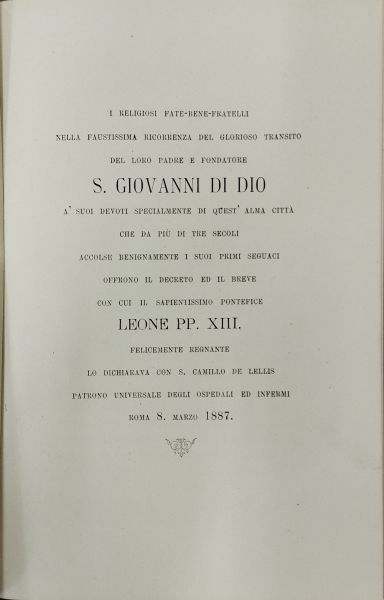
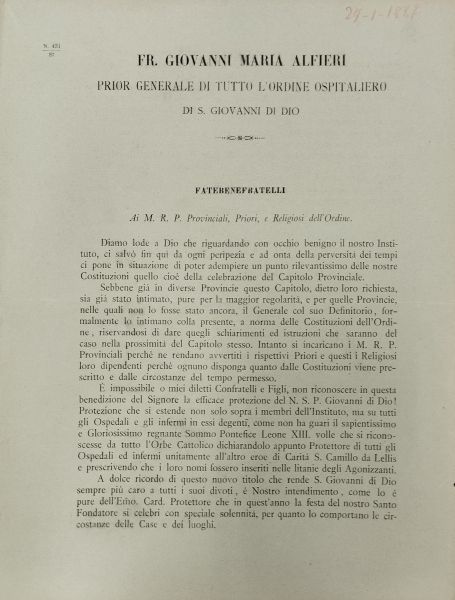
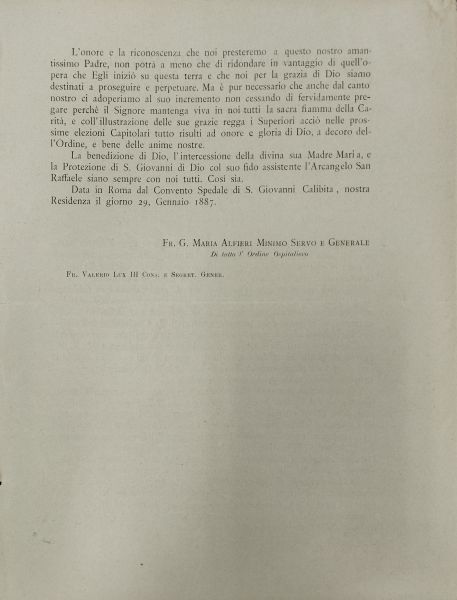
In the following months, the recognition was concretely implemented within
the Order. On January 29, 1887, Fr. Alfieri encouraged a solemn celebration of
Saint John of God’s feast. On March 8, 1887, the proclamation was officially
celebrated at the Church of Saint John Calibita, with the distribution of a
printed booklet containing the Decree of May 27, 1886, and the Brief of June
22, 1886.[1]
The recognition was further strengthened in liturgy and ecclesial practice,
and in 1930 Pius XI extended it to include patronage of nurses and their
associations.
Charity
as the Historical Form of the Church’s Mission
From its origins, the Christian tradition has been marked by an active
presence in places of suffering. Within this context stand the figures of Saint
John of God and Saint Camillus de Lellis, recognized by the Church as eminent
witnesses of charity lived to the point of total self-giving.
The Decree summarizes their witness effectively:
«pari caritatis ardore succensi, animam suam pro aegrotantium salute ponere
non dubitarunt»
(“inflamed with the same ardor of charity, they
did not hesitate to give their lives for the salvation of the sick”).
Both shared the same existential orientation: service to the sick as a
radical expression of Christian charity, though lived in complementary ways.
Saint John of God promoted a renewed vision of healthcare, attentive to
human dignity and practical needs, contributing to a reform of hospitality.
Saint Camillus, on the other hand, emphasized the spiritual dimension of care,
especially in accompanying the dying.
The Decree captures this complementarity:
- Saint Camillus
strengthens souls in their final struggle;
- Saint John of God
provides bodily care while also caring for the salvation of souls.
Thus emerges an integral vision of care, integrating body and spirit.
Charity
and the Social Doctrine of Leo XIII
The Church’s reflection on charity, embodied by these saints, finds
resonance in the teaching of Leo XIII, who also authored the encyclical Rerum
Novarum (1891), considered foundational to Catholic social doctrine.
In it, charity is recognized as an indispensable principle for social
justice, described as the “mistress and queen of all virtues.”[2]
Charity is not an accessory, but the highest form of Christian action,
capable of guiding society toward the good of the person.
There is a profound unity between the 1886 proclamation and later doctrinal
development: both arise from awareness of the integral needs of the human
person—material and spiritual—and from the conviction that only charity fully
responds to them.
The teachings of St John of God also fall within this framework; he urged
us to cherish charity as the ‘mother of all virtues’[3], emphasising its generative role within the
Christian life.
Contemporary Relevance of the Patronage
More than a century on, the title of ‘Patron Saints of Hospitals and the Sick’ remains as relevant as ever. In a context where medicine has achieved extraordinary results on a technical and scientific level, yet sometimes risks losing sight of the centrality of the person, the example set by the two Saints continues to offer criteria for discernment.
In particular, it highlights certain fundamental principles: caring is not simply the same as curing; professional competence requires a human dimension; the sick person is not defined solely by their medical condition.
This gives rise to a model of care that integrates competence, compassion and spiritual care, restoring the sacred dignity of the person to its rightful place at the centre.
Our Patron Saints remind us that love is not merely a collection of good intentions, but a steadfast feeling that passes through the body to reach the fragility of the other; in doing so, love becomes credible and true. True love is the embodiment of compassion that takes shape in concrete acts of care – actions and attitudes that manifest God’s love for every person suffering in body and soul.
The title of ‘Patron’ represents not merely a historical memory, but
constitutes a call that spans history and challenges the present. St John of
God and St Camillus de Lellis bear witness to the fact that charity is not an
abstract ideal, but a living reality, capable of transforming places of
suffering into spaces of dignity, hope and authentic humanity.
Bibliography
P. Francesco Maria RISI, O.H., Bollario
dell’Ordine di S. Giovanni di Dio, Roma, tipogr. degli Artigianelli
S. Giuseppe, 1905.
Fra Giuseppe MAGLIOZZI, O.H., I due Santi
Patroni degli ospedali e dei malati, in Vita ospedaliera, n. 5: pp. 70-73,
1986.
Fra Giuseppe MAGLIOZZI, O.H., S. Camillo de Lellis e S. Giovanni di Dio Patroni degli ospedali e dei malati, pp. 185-191 in «Pagine Juandediane», Roma, Centro Studi San Giovanni di Dio, 1992.
[1]
Archivio Generalizio Ordine Ospedaliero di San Giovanni di Dio - AGF, Santa
Sede. Culto II, XLVII/I/A8, fasc. e; AGF, Santa Sede. Brevi e Decreti,
XLVII/I/B3, fasc. II.
[2]
LEONE XIII, Lett. Enc. Rerum Novarum, (15 maggio 1891), 45.
|
|
|
|
||||||||||||||||||||||||
 |
|||||||||||||||||||||||||||